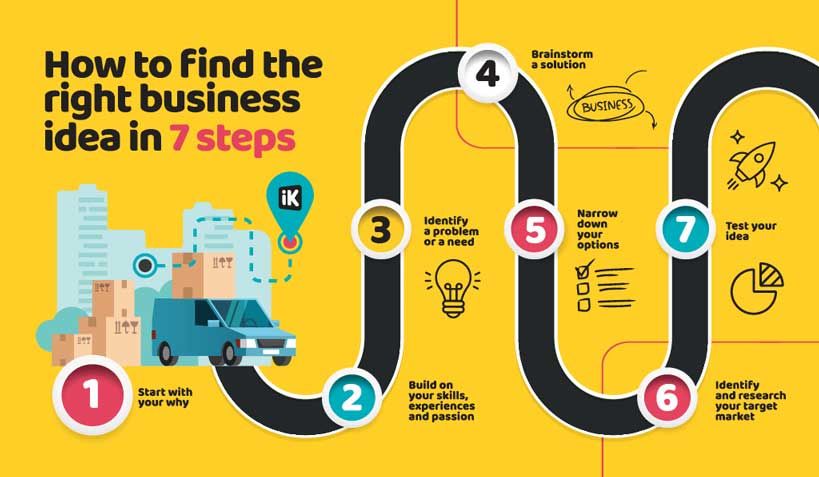
How to Find the Right Business Idea in 7 Easy Steps
Do you have a desire to start a business but not entirely sure what to do next? Here’s how you can find the right business idea that works for you.
BY Yolisa Motha
Table of Contents
- Introduction
- Start with why you want to do this
- Build on what you already know
- Find a real problem worth solving
- Brainstorm without judging the ideas yet
- Narrow it down to the ones that hold up
- Check there's actually a market for it
- Test it before you spend real money
- Once you've found the right business idea
Finding the right business idea is less about waiting for a flash of genius and more about paying attention. Most good businesses start with someone noticing a problem, then checking that other people would actually pay to have it solved. That's most of the game. The romantic version, where a perfect idea arrives in the shower, is rare.
So treat this as a process, not a lightning strike. It takes some honest self-reflection, a bit of research, and a willingness to test the idea before you fall in love with it. Here's how to work through it without losing months stuck in your own head.
Start with why you want to do this
Before the idea, get clear on why you want a business at all. Are you trying to replace a salary, build something on the side, or get out of a job you can't stand? There's no wrong answer, but the honest one matters. It shapes the kind of business that will actually suit you.
Running a business takes more out of you than most people expect, especially in that first year. When sales go quiet near month-end and a client still hasn't paid, your reason for starting is often the only thing keeping you at it. Write it down somewhere you'll see it.
Build on what you already know
You don't need to reinvent yourself to start something. The strongest ideas usually grow out of skills, work experience or interests you already have.
Grab a notebook and answer a few questions honestly. What am I actually good at? What do people already ask me for help with? What could I talk about for an hour without getting bored?
That last one matters more than it sounds. Plenty of people pick an idea that looks great on paper, then quietly give up because they can't stand the day-to-day reality of it. If you already enjoy something and you're decent at it, you've got a head start most people don't have.
It also keeps you cheaper to start. A hairdresser who already owns her clippers, or a guy who's been fixing friends' cars in his yard for years, isn't starting from zero. They're just turning something they already do into something people pay for properly. That shortcut is worth more than a flashy idea you'd have to learn from scratch.
Find a real problem worth solving
An idea only becomes a business when it solves a problem someone will pay to fix. So start looking at the irritations around you, beginning with your own.
What do you find yourself moaning about? What takes too long, costs too much, or just doesn't exist where you live? Maybe there's nowhere nearby to grab fresh bread after work. Maybe the small businesses in your area keep losing sales because they can't take card. Maybe everyone you know battles to find a reliable person to sort out a geyser when the water's been off all day.
Then check it isn't just you. Ask the people around you if the same thing bugs them. South Africans build businesses out of these everyday gaps all the time, from a spaza shop on a busy corner to a weekend baking setup run off a WhatsApp group. The common thread is a real need, not a clever idea floating in a vacuum.
Keep your eyes open when you're out and about, too. The best problems to solve are often the ones people have quietly accepted as normal, the small daily annoyances nobody's bothered to fix yet. That's usually where the gap is.
Brainstorm without judging the ideas yet
Once you've spotted a problem or two, give yourself room to come up with solutions. This part works better when you're not being precious about it.
Keep something on you to write in, or just use your phone. Ideas tend to show up at inconvenient times: in a taxi, in a queue, right as you're falling asleep. Write them all down, even the rubbish ones. Half of them will go nowhere, but a bad idea often points you towards a good one once your brain has had time to chew on it.
Don't filter anything yet. The sorting comes later, and it's easier when you've got plenty to sort.
Narrow it down to the ones that hold up
By now you've probably got a messy list. Time to be a bit ruthless with it.
Run each idea past three simple questions.
- Does it line up with your why?
- Can you honestly see yourself doing it for the next few years?
- And does it solve a problem people will pay for?
A strong contender clears all three, not just one of them.
Here's the uncomfortable bit. Something can be exciting and still be a terrible business. Something can be profitable and still make you miserable. The right business idea is the one that's both worth your effort and something you won't resent six months in. That balance is the whole point of narrowing down.
Check there's actually a market for it
No matter how good your idea feels, you need to know who would buy it. Research your target market properly: who they are, roughly how old, where they live and work, and what they already spend money on.
If something like your idea already exists, that's not a bad sign. It usually means there's demand. Go and talk to the people using your would-be competitors. What do they like? Where are those businesses letting them down? The gaps people complain about are your way in.
You don't need a big budget to do this. Face-to-face conversations are best, but social media, online reviews and a quick poll in a community group will tell you a lot. The goal is to swap your assumptions for something closer to the truth before you commit.
Pay attention to how people in your area actually spend, as well. Price sensitivity is real here, and what sells in one suburb can flop a few kilometres away. Someone happy to pay R45 for a coffee in one part of town won't be in another. The closer your idea sits to what your specific market can and will spend, the less you'll have to scrap for every sale.
Test it before you spend real money
This is the step most people skip, and it's the one that saves you. Testing means putting your idea in front of real customers before you've sunk your savings into stock or signage.
Sell a small batch. Take a handful of orders. Offer the service to one paying client and see if they come back. You'll learn things no amount of planning can teach you: what people will actually pay, what they grumble about, how much hassle the work really is. Maybe your stock arrives late and you realise your supplier is going to be a problem. Maybe people love it and you can barely keep up. Either way, you find out while the stakes are still small.
You don't need much money to test an idea, either. There are plenty of businesses you can start on a small budget that prove themselves before they cost you much. An idea that survives contact with real customers is worth backing. One that flops just saved you a fortune.
Once you've found the right business idea
Finding the right business idea takes time, and that's normal. If you've worked through your why, built on what you already know, found a real problem and tested a solution people will pay for, you're in a far stronger position than most people who start on a hunch.
The next step is turning that idea into an actual business. When you're ready, our guide on how to start a business in South Africa walks you through the practical side, from choosing a structure to landing your first paying customer.
Take your time getting the idea right. Everything after it gets easier when the foundation is solid.