Thread by thread: the story of Kwenzi Nkomo
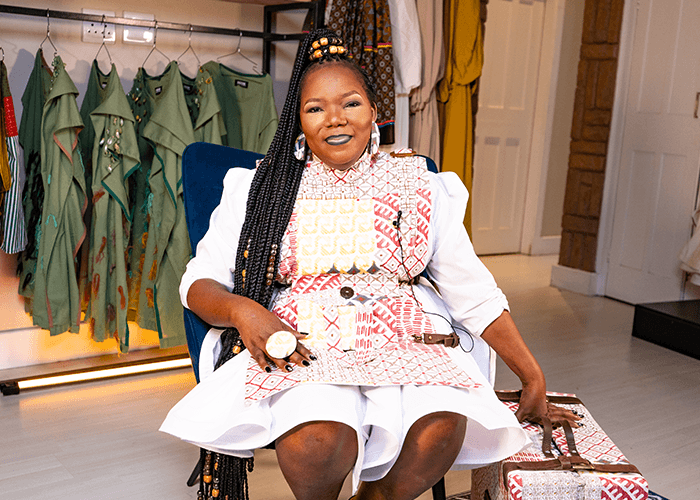
Kwenzi Nkomo’s journey is one of survival, self-discovery and turning pain into purpose. Through Indoni Fashion House, she has transformed those experiences into garments that carry her story, her strength and her sense of identity.
BY Sarah Heron
Table of Contents
- Introduction
- What inspired you to start this business?
- How did experimenting with clothes turn into a business?
- What did the early days of Indoni look like?
- Is that how Indoni Fashion House started?
- What experiences have influenced the way you work?
- What wisdom would you like to share with up-and-coming fashion designers and business owners?
- Built on purpose; driven by “why”
Starting, running and growing a business rarely happens in a straight line. It’s messy, unpredictable, and full of moments that test whether you really want it.
Kwenzi Nkomo’s story is shaped by resilience and reinvention. She found purpose in unexpected places, and, like many others, it was in the middle of the struggle that her path became clear.
What began as a straightforward conversation with Kwenzi became an unforgettable conversation about grit, growth and perseverance.
What inspired you to start this business?
My father was the only provider at home, and my mother had never worked. When he passed away, the nuns who taught at my school offered to help but the only way for them to assist was for me to live with them.
Because of that, school dress-up days were stressful because I didn’t have nice clothes. All we had were donations, and children often mocked us. I was bullied a lot for my clothes, my surname and especially for the marks on my face. In school, fashion slowly became an escape, even before I understood it as a craft.

How did experimenting with clothes turn into a business?
After leaving school, I started redesigning simple T‑shirts and skirts by hand, adding beads, tearing and reshaping garments. People loved what I created and began placing orders. Basically, that’s what forced me to go to college. But fashion was also a way to distract people from looking at my face. I also loved unconventional hairstyles, and I still make statement hair pieces today. In a way, that’s how the brand was born.
So, after people started placing orders, I knew deep down in my heart that I wanted to learn fashion.
I approached a fabric shop owner who used to sell me materials, hoping he would teach me, but he was busy. That’s when I looked for an affordable fashion school.
During college, money was tight. I had to pay fees monthly, so I also sold fish at a nearby factory every morning before class. That business helped me fund my studies.
But school wasn't enough. I sought extra mentorship from Durban designers to learn the professional techniques that I wanted to master. By then, I already had clients, and the work helped me earn an income.
What did the early days of Indoni look like?
Indoni really began after I attended my first fashion show in Durban. I was blown away and knew it was something I wanted to do.
I applied for the Durban Fashion Mentorship programme, but my first application was rejected. I tried again the following year and got accepted even though I was heavily pregnant at the time. My daughter was one month old when the programme started.
Balancing classes, a newborn, and my small business was overwhelming, but I pushed through. In 2014, I showcased at the Durban Fashion Fair and received a standing ovation. I still didn’t make the top three, partly because of my circumstances, and it crushed me. The nuns had once told me I’d never make it, and their voices echoed in that moment but not winning opened other doors.

Is that how Indoni Fashion House started?
The response to my 2014 collection was incredible. People wanted every piece from that runway, and I even ran out of fabric. A manager from Young Designers Emporium approached me after the show and invited me to supply the store. Within a week, all my pieces sold out. That experience taught me a lot about retail and quality.
The following year, Greg Wallace offered me mentorship and another chance to showcase at DFF and that’s how Indoni Fashion House began.
What experiences have influenced the way you work?
Running a business, guys, is not child’s play.
I’ll go back to around the year 2023. A lot happened that year.I lost two of my employees, people I had been together for a long time. One of them was my assistant and we had grown close. The other was a seamstress who I worked with for five years.
It’s challenging when your business grows and because nobody tells you that you’ve grown - and you continue doing things the way you did when you first started. WhenI noticed the growth, I had to change the way we did things and because of those other experiences, I try to treat my team like my family.

What wisdom would you like to share with up-and-coming fashion designers and business owners?
I didn't know that fashion could change lives, so I'd say, remember why you started at the first place.It’s not about meeting celebrities; all that found me along the way.
So, I would say to the upcoming business owners or designers: do not forget why you started. Keep doing, keep producing, keep creating, you will find your tribe along the way.

Built on purpose; driven by “why”
Through all the struggles and setbacks, one thing stands out in Kwenzi’s story. It is knowing her “why.” It’s what carried her through uncertainty and continues to guide how she grows. Because when you’re clear on why you started, you can face the chaos a little differently. Not as something to fear, but as part of the journey.
Support Kwenzi and the journey of Indoni Fashion House by following, and investing in local design here:
Website: indonifashionhouse.com
Instagram: @indonifashionhouse